Table of Contents
- What is Generative AI and How Does Generative AI Work?
- Popular Types of Generative AI
- Real-World Applications of Generative AI
- What Generative AI Is Good At vs Bad At?
- Popular Generative AI Tools in 2026
- How to Start Learning Generative AI
- The Future of Generative AI
- Conclusion
Quick Overview
- By identifying patterns in enormous datasets and producing unique results in response to human input, generative AI is a kind of artificial intelligence that produces entirely new content, including text, images, audio, video, and code.
- Learn about the main technologies that underpin generative AI, such as prompts, Large Language Models (LLMs), content creation capabilities, and the distinctions between AI-powered and conventional software.
- Discover the main categories, uses, and resources that are propelling the adoption of generative AI, from text, image, video, audio, code, and design generation to practical applications in marketing, healthcare, education, finance, software development, and corporate productivity.
- Discover the advantages and disadvantages of generative AI, including its abilities in writing, summarizing, coding, and brainstorming as well as its drawbacks, which include hallucinations, factual errors, flawed thinking, and the significance of using AI responsibly.
- Learn how to begin studying generative AI and get ready for its future with prompt engineering, practical projects, certifications, well-known AI platforms, new trends like AI agents and multimodal AI, and the abilities required to prosper in an AI-driven world.
What is Generative AI and How Does Generative AI Work?
Instead than merely retrieving preexisting data, generative AI (GenAI) generates new content, including text, graphics, code, audio, and videos, in response to human instructions.
Generative AI learns patterns from large datasets to create unique, human-like outputs for a variety of tasks, in contrast to traditional software that adheres to predetermined rules.
Generative AI Definition in Simple Words
To put it simply, generative AI is artificial intelligence that produces original content rather than merely locating or arranging preexisting data. In order to produce unique answers in response to human inputs, it learns from massive datasets to comprehend patterns, relationships, and language.
Think of it this way:
- Traditional software retrieves or processes existing information based on fixed rules.
- Generative AI creates something new by predicting what should come next based on everything it has learned during training.
For example:
| Traditional Software | Generative AI |
| Retrieves information from a database | Creates new content from a prompt |
| Follows predefined rules | Learns patterns from training data |
| Returns existing answers | Generates original responses |
Why Is It Called “Generative”?
The term “generative” refers to the AI’s capacity to produce original material as opposed to merely retrieving pre-existing data.
It is called Generative AI because it:
- Creates original text, images, videos, music, code, and other content.
- Doesn’t simply search a database for answers.
- Learns patterns, structures, and relationships from massive amounts of training data.
- Predicts the most likely output based on the prompt you provide.
For example, if you ask, “Write a product description for wireless headphones,” the AI doesn’t copy an existing description. Instead, it generates a brand-new one by applying patterns it learned during training.
What Can Generative AI Create?
The capacity of generative AI to create a wide variety of content is one of its main advantages. Depending on the prompt and the AI model, it can produce:
- Text: Blog posts, emails, articles, reports, summaries, and social media captions.
- Images: Digital artwork, product mockups, illustrations, and marketing visuals.
- Videos: Promotional videos, animations, explainer videos, and short-form content.
- Music: Original songs, background music, melodies, and soundtracks.
- Code: Website code, Python scripts, SQL queries, debugging suggestions, and automation workflows.
- Audio: Voiceovers, speech generation, podcasts, and audio narration.
- Designs: Logos, presentations, user interface (UI) concepts, and marketing creatives.
- Documents: Business proposals, resumes, presentations, meeting notes, and project plans.
How Does Generative AI Work?
Despite the apparent intelligence of generative AI, its underlying mechanism is remarkably methodical. Unlike humans, it is unable to “interpret” information. Rather, it predicts the best answer to a given prompt by identifying patterns in vast volumes of data.
At a high level, the process works like this:
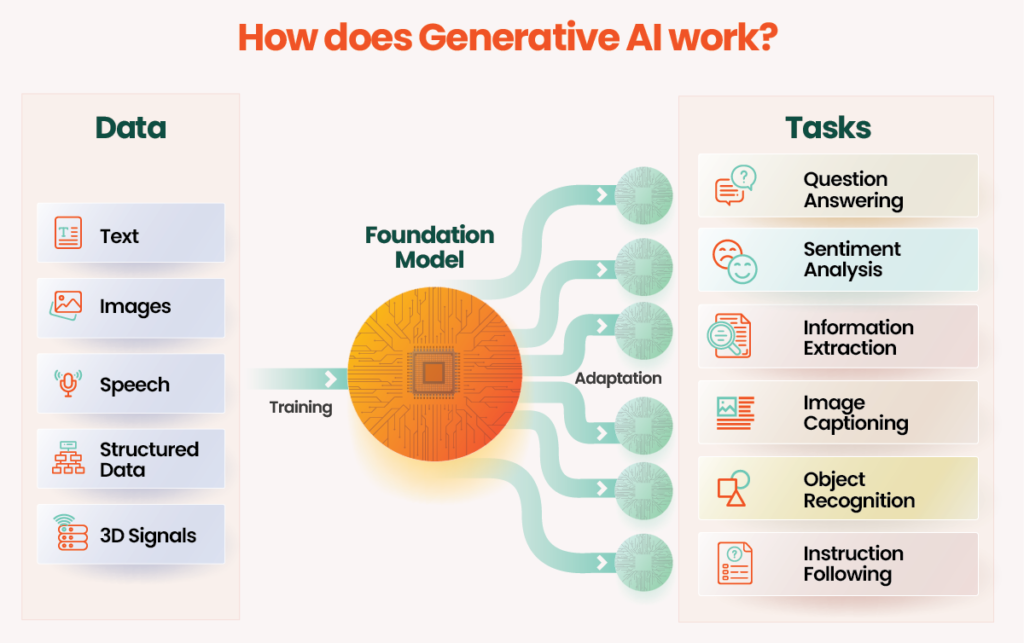
Here’s what happens at each stage:
- Data Collection: Large volumes of text, photos, code, audio, and other publicly accessible or licensed data are used to train AI models.
- Training: During training, the model learns grammar, relationships, structures, and patterns rather than memorizing exact answers.
- Pattern Learning: It identifies how words, images, and concepts are connected so it can predict likely outputs.
- Prompt: A user provides an instruction, question, or request.
- Response Generation: The AI predicts the most probable sequence of words, pixels, or code to generate a relevant response.
This entire process happens within seconds, allowing AI tools to create content almost instantly.
What are Large Language Models (LLMs)?
Large Language Models (LLMs) fuel the majority of contemporary text-based Generative AI products. An LLM is a kind of AI model that has been trained on massive datasets to comprehend and produce language that is similar to that of humans.
LLMs learn how language functions by identifying patterns in billions of words rather than storing predetermined answers.
Some of the most popular LLMs include:
- GPT is extensively utilized for writing, coding, research, and conversational AI and powers ChatGPT.
- Gemini: Google’s multimodal AI model that can work with text, images, code, and more.
- Claude: Developed by Anthropic, known for long-form writing, analysis, and reasoning.
- Llama: Meta’s family of open-source language models used for research and enterprise AI applications.
Many AI assistants, productivity tools, and commercial apps that are currently in use are built on these models.
Generative AI models come in a variety of forms, including large language models. Examine the distinctions between LLMs, GANs, and Diffusion Models and their respective applications if you are interested in how image generators, video AI, and other models operate.
What are Prompts?
The guidance or query you pose to a generative AI model is called a prompt. Your prompt’s clarity and specificity have a major impact on the AI’s answer quality.
Consider prompts as guidelines. The AI will be better able to comprehend your intent and produce helpful results if you give it additional context.
For example:
| Prompt | Likely Output |
| “Write a blog.” | A generic blog post |
| “Write a 700-word blog explaining email marketing for small businesses with three practical examples.” | A detailed, targeted article |
| “Summarize this PDF in five bullet points.” | Concise summary |
| “Explain blockchain like I’m 10 years old.” | Beginner-friendly explanation |
A well-written prompt often includes:
- The task you want completed.
- Relevant context or background.
- The desired format.
- Tone or writing style.
- Length or word count.
- Target audience.
Learning how to write better prompts, often called prompt engineering, is one of the easiest ways to improve AI-generated outputs.
Why AI Doesn’t “Think”?
The idea that generative AI “thinks” like a human is one of the most common misconceptions about it. It actually lacks consciousness, feelings, beliefs, and the capacity for independent thought.
Instead, AI works by:
- Using patterns discovered during training to predict the most likely next phrase, picture, or piece of code.
- Determine which answer is most likely to satisfy the prompt using probability.
- Recognizing relationships between concepts without truly understanding them.
This is why AI can sometimes produce fluent, convincing responses that are incorrect, a phenomenon known as AI hallucination. It generates what is statistically likely rather than verifying factual accuracy.
Popular Types of Generative AI
Beyond text-based chatbots, generative AI can now produce a variety of digital material. It can produce everything from realistic photographs and written articles to software code, music, films, and even 3D designs, depending on the type of model. You can select the best AI tool for your particular requirements by being aware of these categories.
- Text Generation: Generates written content from natural language prompts that is human-like, including blog posts, emails, reports, summaries, product descriptions, and chatbot responses.
- Image Generation: Produces original images, illustrations, artwork, logos, and marketing creatives based on text descriptions without requiring graphic design skills.
- Video Generation: Makes video creation quicker and easier by using text prompts, graphics, or scripts to create films, animations, AI avatars, and visual storytelling content.
- Audio & Music Generation: Creates realistic voiceovers, podcasts, sound effects, and original music compositions for content creators, educators, and businesses.
- Code Generation: Assists developers by writing code, debugging errors, explaining programming concepts, generating documentation, and automating repetitive coding tasks.
- 3D & Design Generation: Generates 3D models, UI/UX designs, product prototypes, architectural concepts, and other digital assets to accelerate design and visualization workflows.
Real-World Applications of Generative AI
By automating repetitive processes, increasing efficiency, and facilitating quicker decision-making, generative AI is revolutionizing a number of sectors. Businesses from all industries are using generative AI to improve consumer experiences, cut expenses, and expedite processes, from producing marketing content to helping with medical research.
Applications of Generative AI Across Industries
| Industry | Example Use Case | Key Benefit |
| Marketing | Content creation, email campaigns, ad copy | Faster content production and personalization |
| Software Development | Code generation, debugging, documentation | Improved developer productivity |
| Healthcare | Clinical documentation, drug research | Better efficiency and reduced administrative workload |
| Education | Personalized learning, quizzes, tutoring | Enhanced learning experience |
| Finance | Financial reports, customer communication | Faster analysis and improved operational efficiency |
| Manufacturing | Product design, predictive maintenance | Improved productivity and innovation |
| Customer Support | AI chatbots, ticket summarization | Faster response times and 24/7 support |
| Media & Entertainment | Script writing, video and music generation | Accelerated creative workflows |
| HR & Recruitment | Resume screening, job descriptions, onboarding | Streamlined hiring and HR processes |
Everyday Examples of Generative AI You Already Use
Nowadays, a lot of well-known apps use generative AI to help users work more quickly and creatively. Typical instances include the following:
- ChatGPT: Generates text, answers questions, and assists with writing and coding.
- Google Gemini: Helps with research, content creation, and Google Workspace tasks.
- Microsoft Copilot: Assists with writing, presentations, spreadsheets, and emails in Microsoft 365.
- Grammarly AI: Improves writing by correcting grammar, rewriting text, and adjusting tone.
- Canva Magic Studio: Creates AI-generated designs, presentations, and social media content.
- Adobe Firefly: Generates and edits images using text prompts.
- Notion AI: Summarizes notes, drafts documents, and organizes information.
- GitHub Copilot: Suggests code and helps developers write software faster.
What Generative AI Is Good At vs Bad At?
Despite its immense strength, generative AI is not flawless. You can use it more wisely and successfully if you are aware of its strengths and weaknesses.
What Generative AI Is Genuinely Good At?
Generative AI performs exceptionally well at:
- Drafting and writing: Creates emails, blogs, reports, and social media content quickly.
- Brainstorming and ideation: Generates creative ideas, alternatives, and content outlines.
- Coding assistance: Writes code, explains concepts, and helps debug programs.
- Translation: Translates content across multiple languages with high accuracy.
- Summarization: Condenses lengthy documents into concise key points.
- Explanation and teaching: Simplifies complex topics with examples and step-by-step explanations.
Where Generative AI Still Falls Short?
Despite its capabilities, Generative AI has important limitations:
- Factual precision: Can produce incorrect or outdated information.
- Real-time information: May not know recent events unless connected to live web search.
- Math and calculations: Can make arithmetic and logical errors.
- Legal and ethical judgment: Cannot replace professional advice.
- Long-term memory: Often doesn’t remember previous conversations unless context is provided.
- Physical world interaction: Cannot interact with the real world without connected devices or tools.
Understanding the Hallucination Problem
AI hallucinations are one of the main drawbacks of generative AI. This occurs when an AI model provides a response that appears assured and credible but is in fact, inaccurate, deceptive, or even fabricated.
Generative AI uses patterns it has learnt during training to forecast the most likely response, as opposed to a search engine that gets verified information. As a result, it may occasionally produce fictitious numbers, dates, facts, or even citations to nonexistent articles.
AI might produce a realistic-looking citation that was never published, for instance, if you ask it where a research study came from. In a similar vein, it may confidently give the incorrect response to a scientific or historical query without expressing uncertainty.
This indicates that you should utilize generative AI carefully, not that it is unreliable. It is most effective when used for brainstorming, content drafting, information summarization, and learning new concepts; nevertheless, crucial information should always be confirmed by reliable sources.
Best Practice: Generative AI should be used as a starting point rather than the ultimate authority. Before depending on information, always double-check crucial facts, figures, citations, and expert advice with reliable and current sources.
- Chatbots: Tools like ChatGPT, Claude, and Gemini help with writing, research, brainstorming, coding, and answering questions.
- Image AI: Midjourney, Adobe Firefly, and DALL·E generate images, illustrations, logos, and other creative visuals from text prompts.
- Video AI: Runway, Google Veo, and Pika create AI-generated videos, animations, and visual content.
- Coding AI: GitHub Copilot, Cursor, and Amazon Q Developer assist developers with writing, debugging, and explaining code.
- Research AI: Perplexity AI, ChatGPT Search, and Gemini help users search, summarize, and understand information from multiple sources.
- Presentation AI: Gamma, Canva Magic Design, and Microsoft Copilot generate presentations and slide decks quickly with minimal effort.
- Productivity AI: Notion AI, Grammarly AI, and Microsoft Copilot help users write, edit, summarize, and organize everyday work more efficiently.
How to Start Learning Generative AI
It is not necessary to have a technical background or coding skills to begin using Generative AI. Beginners can rapidly develop useful skills by practicing with well-known AI tools and adhering to a defined learning path.
- Learn AI Basics: Understand core concepts such as artificial intelligence, machine learning, Generative AI, and Large Language Models (LLMs).
- Understand Prompt Engineering: Learn how to write clear and specific prompts to get better and more accurate AI-generated responses.
- Explore Popular Tools: Start using beginner-friendly tools like ChatGPT, Gemini, Claude, and Microsoft Copilot for everyday tasks.
- Build Small Projects: Practice by creating blog posts, summarizing documents, generating images, or building simple AI-powered applications.
- Take Certifications: Enroll in beginner-friendly Generative AI courses or certifications to gain structured knowledge and hands-on experience.
- Join AI Communities: Participate in AI forums, LinkedIn groups, Reddit communities, and online events to learn from experts and stay updated.
Learning Timeline
| Timeline | What to Focus On |
| Week 1 | Learn AI basics and explore popular Generative AI tools. |
| Week 2 | Practice writing prompts and experiment with different use cases. |
| Month 1 | Build small projects and use AI for daily tasks. |
| Month 3 | Complete a certification, create a portfolio, and join AI communities. |
The Future of Generative AI
You might be surprised to learn how close generative AI is to the future. What began as AI chatbots is quickly becoming into intelligent systems that can produce content, automate processes, resolve challenging issues, and help with routine activities in a variety of industries.
AI agents, multimodal AI, smaller AI models, enterprise AI, and personalized AI assistants are some of the developments that will make these tools more potent, usable, and accessible for both individuals and enterprises over the coming
years. Stricter laws governing AI will also promote its adoption in a safer and more responsible manner.
The easiest approach to get ready is to start developing useful AI skills now rather than anticipating every new development. Discover the fundamentals, try out common tools, and maintain your curiosity. As AI develops, those that know how to collaborate with it will be in a better position to adjust and prosper.
Conclusion
The way humans create, learn, work, and solve issues is being transformed by generative AI. It provides a plethora of potential for both individuals and businesses, ranging from producing text, images, videos, and code to increasing productivity across industries. But it is just as crucial to comprehend its potential, constraints, and appropriate use. You may confidently start your Generative AI journey and stay ready for an AI-powered future by studying the fundamentals, honing your prompt-writing skills, and experimenting with well-known AI tools.
Get individualized advice on selecting the best course, career path, and certification for your objectives by getting in touch with specialists.
Frequently Asked Questions (FAQs)
1. Are artificial intelligence (AI) and generative AI the same thing?
No, the more general field of building machines that can carry out activities requiring human ability is known as artificial intelligence (AI). A subtype of artificial intelligence called “generative AI” is dedicated to producing original content, including literature, pictures, movies, music, and code. Not all AI systems are generative AI, even if every generative AI is AI.
2. What is Generative AI’s primary objective?
Generative AI’s primary objective is to produce fresh, unique information in response to user input. It generates text, photos, code, audio, videos, and other stuff that resembles human-created work by learning patterns from massive databases rather than just accessing pre-existing information.
3. Do I need coding skills to use Generative AI?
No. Most Generative AI tools are designed for beginners and can be used through simple text prompts without any coding knowledge. However, learning programming can help if you want to build AI applications, automate workflows, or customize AI models.
4. What improves the response quality of Generative AI?
Clear and detailed prompts significantly improve the response quality of Generative AI. Providing context, specifying the desired format, tone, target audience, and objective helps AI generate more accurate, relevant, and useful outputs.
5. Is content created by Generative AI copyright protected?
Different countries and platforms have different copyright laws for work created by AI. While entirely AI-generated content may have various legal implications, content that is highly edited or incorporates human creativity may frequently be protected by copyright. Always review the conditions of the AI tool you use as well as local copyright regulations.
6. What type of data is Generative AI most suitable for?
Generative AI is most suitable for unstructured data such as text, images, audio, video, and source code. It can also work with structured data in certain use cases, but it performs best when generating or understanding rich, content-based information.
7. What are some ethical considerations when using Generative AI?
Some important ethical considerations when using Generative AI include protecting user privacy, reducing bias, preventing misinformation, respecting intellectual property rights, ensuring transparency, and using AI responsibly. Human review remains essential for high-stakes decisions and published content.
8. What is the responsibility of developers using Generative AI?
The responsibility of developers using Generative AI is to build and deploy AI systems responsibly. This includes protecting sensitive data, minimizing bias, testing outputs for accuracy, complying with regulations, and ensuring AI is used ethically and transparently.
9. How has Generative AI affected security?
By assisting with threat detection, security task automation, and vulnerability analysis, Generative AI has enhanced cybersecurity. AI-generated phishing emails, deepfakes, and malicious code are just a few of the new security threats it has brought about, making responsible AI governance even more crucial.
10. How can I stay updated with the latest Generative AI developments?
Following reputable AI blogs, research journals, newsletters, online groups, and official announcements from top AI businesses is beneficial because the AI field is always changing. One of the easiest ways to stay up to date is to regularly practice using new tools and capabilities.